Pride and Prejudice
Pride and Prejudice is a sharp, witty critique of Regency society that remains surprisingly relevant today. Studying this text rewards candidates who can unpick Austen's ironic narrative voice and analyse how personal flaws and societal expectations shape the central relationship.
Study Notes
Overview
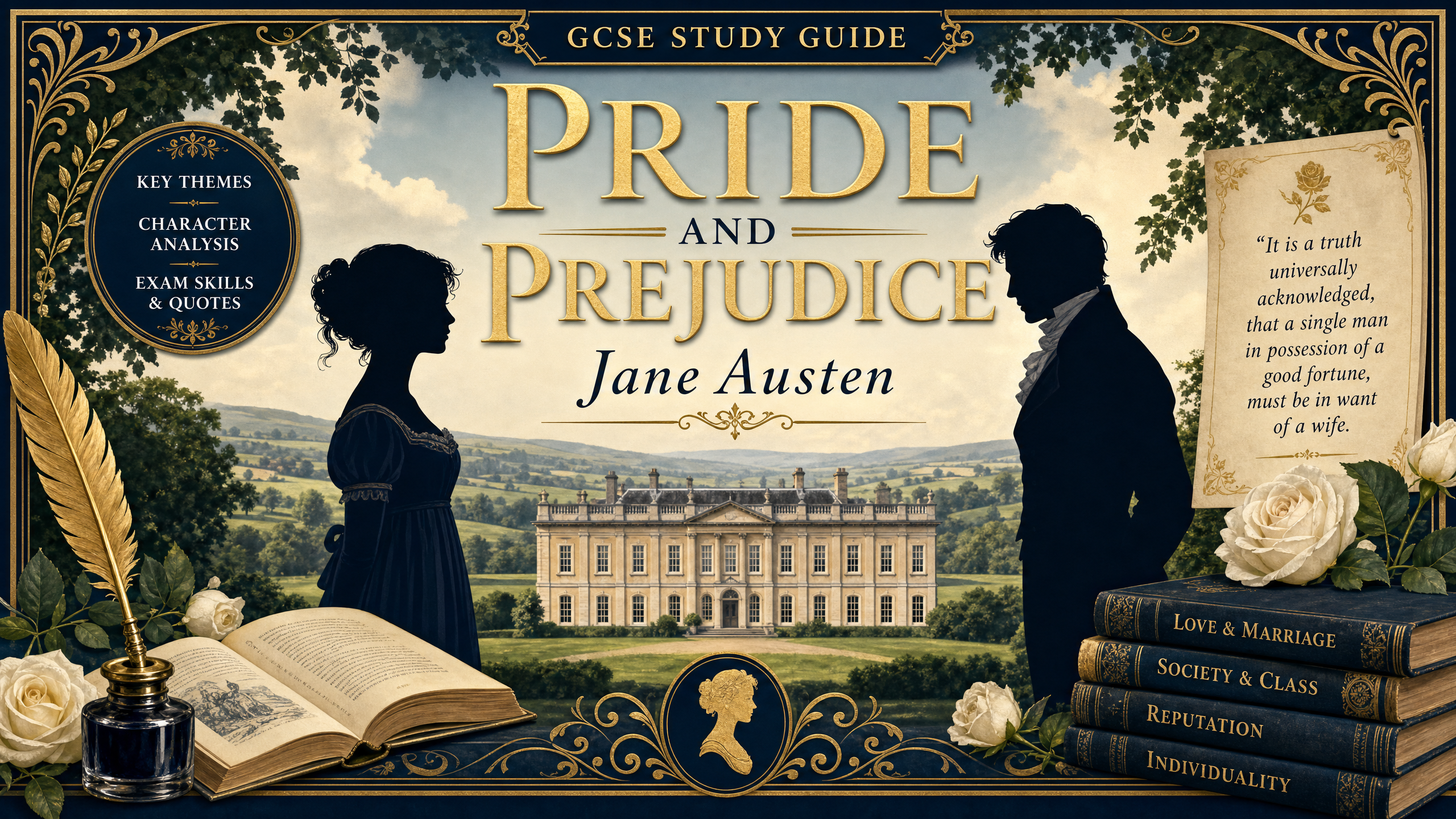
Jane Austen's Pride and Prejudice (1813) is a masterclass in social satire and character development. Set against the backdrop of the Regency marriage market, it exposes the economic vulnerability of women while celebrating the possibility of a union based on mutual respect and intellectual equality. Examiners look for candidates who move beyond plot summary to analyse Austen's narrative methods—particularly her use of irony and free indirect discourse—and who can integrate context seamlessly to show how societal pressures drive character behaviour.
Plot/Content Overview
- Volume 1: The arrival of Mr Bingley and Mr Darcy at Netherfield sets the plot in motion. Elizabeth is prejudiced against Darcy after he slights her at a ball, while Darcy's pride makes him disdain the Bennet family's lower social standing. Mr Collins proposes to Elizabeth and is rejected, subsequently marrying Charlotte Lucas.
- Volume 2: Elizabeth visits Charlotte and encounters Darcy at Rosings. Darcy unexpectedly proposes, insulting Elizabeth's family in the process. She furiously rejects him, citing his interference in Jane's romance and Wickham's false claims. Darcy's subsequent letter forces Elizabeth to re-evaluate her prejudice.
- Volume 3: Elizabeth visits Pemberley and sees Darcy's true character. The crisis of Lydia's elopement with Wickham threatens the family's ruin, but Darcy secretly intervenes to save them. The novel resolves with the marriages of Jane to Bingley and Elizabeth to Darcy, representing the triumph of mutual understanding over pride and prejudice.
Themes
Theme 1: Marriage as a Social and Economic Contract
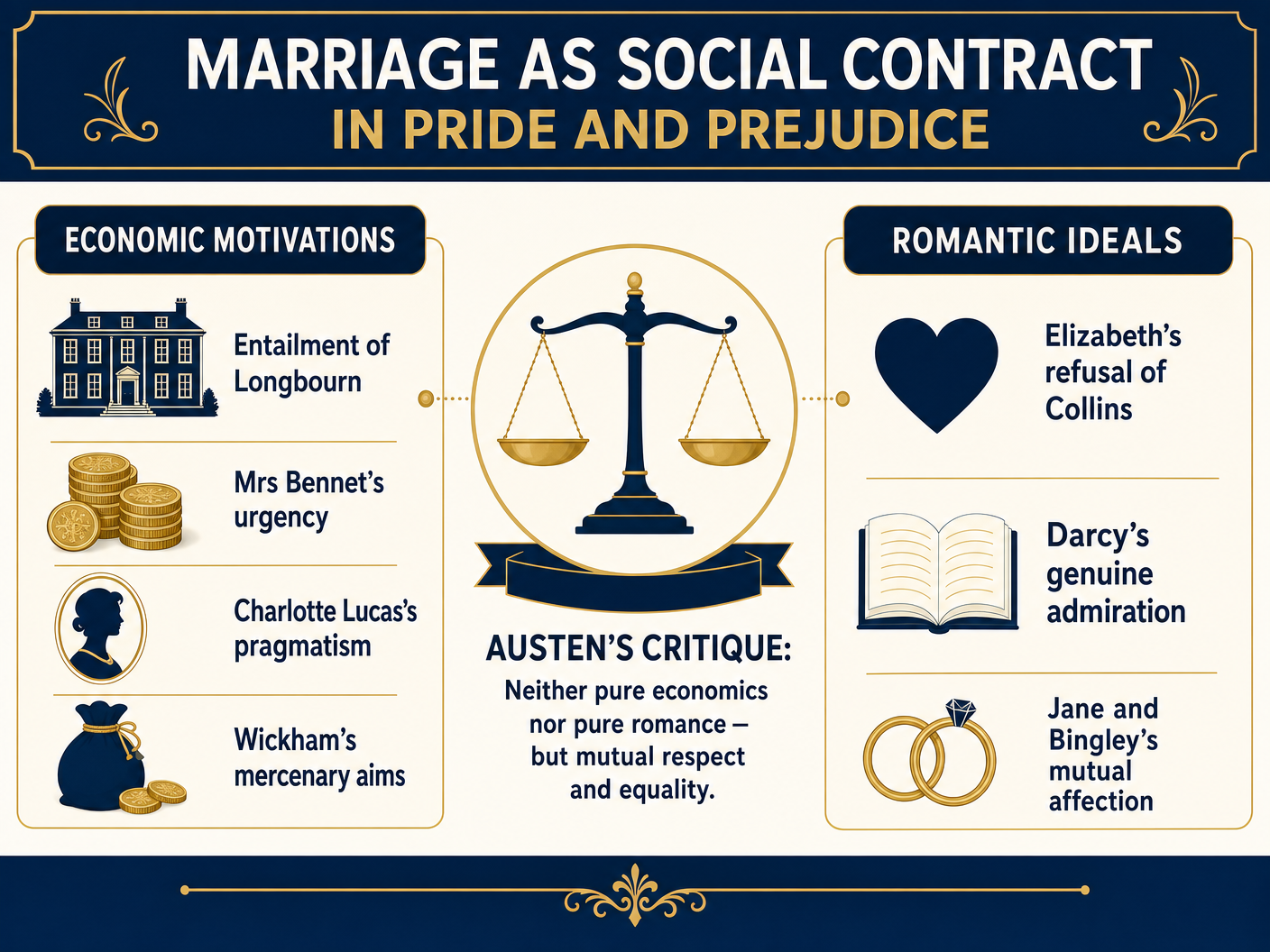
Austen critiques a society where marriage is the only viable career for a respectable woman. She presents a spectrum of marriages: the mercenary (Wickham and Lydia), the pragmatic (Charlotte and Collins), and the ideal (Elizabeth and Darcy).
Key Quotes:
- "It is a truth universally acknowledged, that a single man in possession of a good fortune, must be in want of a wife." (Vol 1, Ch 1) - Austen's ironic opening exposes society's commodification of marriage.
- "I am not romantic, you know. I never was. I ask only a comfortable home." (Vol 1, Ch 22) - Charlotte Lucas articulates the grim economic reality facing unmarried women.
Theme 2: Pride and Prejudice
Both central characters suffer from both flaws. Darcy's pride blinds him to Elizabeth's worth initially, while Elizabeth's prejudice, fueled by her own injured pride, makes her misjudge both Darcy and Wickham.
Key Quotes:
- "She is tolerable; but not handsome enough to tempt me." (Vol 1, Ch 3) - Darcy's initial pride and rudeness.
- "How despicably have I acted!... I, who have prided myself on my discernment!" (Vol 2, Ch 13) - Elizabeth's moment of self-realisation after reading Darcy's letter.
Character Analysis
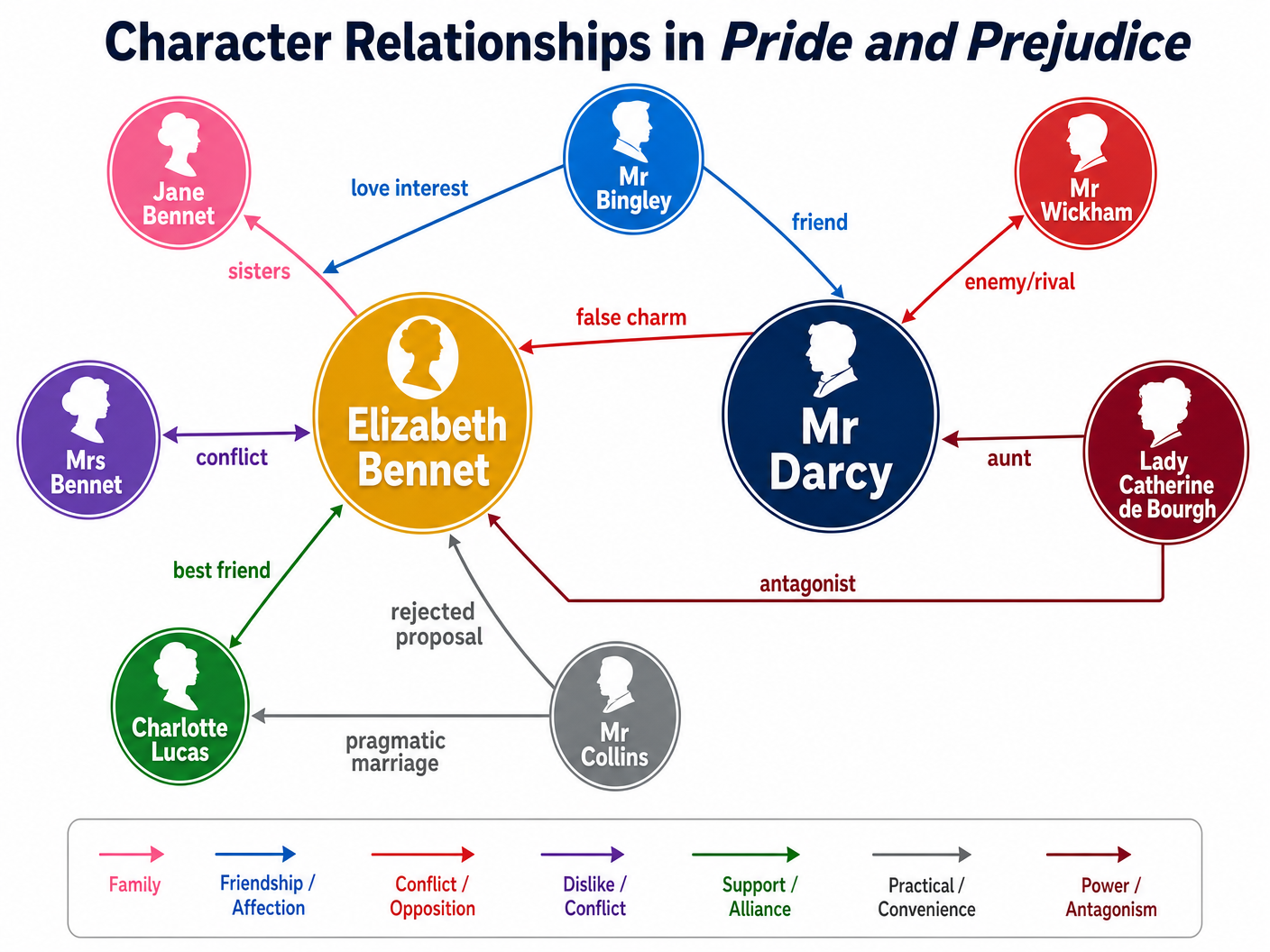
Elizabeth Bennet
Role: The protagonist; her journey towards self-knowledge forms the moral centre of the novel.
Key Traits: Intelligent, witty, independent, but quick to judge.
Character Arc: Moves from misplaced confidence in her own judgement to humility and genuine understanding.
Essential Quotes:
- "There is a stubbornness about me that never can bear to be frightened at the will of others. My courage always rises with every attempt to intimidate me."
- "Till this moment, I never knew myself."
Fitzwilliam Darcy
Role: The aristocratic male lead whose transformation mirrors Elizabeth's.
Key Traits: Proud, reserved, deeply principled, socially awkward.
Character Arc: Learns to overcome his class prejudice and values Elizabeth's mind over her lack of connections.
Essential Quotes:
- "My good opinion once lost is lost forever."
- "By you, I was properly humbled."
Writer's Methods
- Free Indirect Discourse: Austen blends the narrator's voice with Elizabeth's thoughts, allowing the reader to experience Elizabeth's prejudice while maintaining enough distance to critique it.
- Irony and Satire: Used extensively to expose the hypocrisy of characters like Mr Collins and Lady Catherine, and the absurdity of the marriage market.
- Dialogue: Character is revealed through speech. Mr Collins's verbose, sycophantic speeches contrast with Darcy's reserved, direct manner and Elizabeth's witty sparring.
Context
- The Regency Marriage Market: Women could not inherit property or enter professions; marriage was essential for survival.
- Entailment: The legal restriction on the Longbourn estate means it must pass to a male heir (Mr Collins), driving Mrs Bennet's desperate attempts to marry off her daughters.
- Class Structure: The tension between the landed aristocracy (Darcy, Lady Catherine) and the rising professional/trade classes (the Gardiners, the Bennets). Austen advocates for an aristocracy of merit rather than mere birth.
Podcast Episode
Listen to our comprehensive revision podcast covering all the essential topics for your exam:
Visual Resources
2 diagrams and illustrations
Interactive Diagrams
1 interactive diagram to visualise key concepts
Conceptual Flow Outline
Elizabeth Bennet's Character Arc
Worked Examples
2 detailed examples with solutions and examiner commentary
Practice Questions
Test your understanding — click to reveal model answers
How does Austen present the relationship between Jane Bennet and Mr Bingley? (30 marks)
Hint: Consider how their relationship contrasts with Elizabeth and Darcy's, and how it is affected by the interference of others.
Explore how Austen presents the theme of social class in Pride and Prejudice. (30 marks)
Hint: Look at Lady Catherine de Bourgh, Mr Collins's sycophancy, and the Gardiners.
Starting with this extract (Mr Collins's proposal, Vol 1, Ch 19), explore how Austen presents men's attitudes towards women. (30 marks)
Hint: Contrast Mr Collins's dismissive attitude with Darcy's evolving respect for Elizabeth's mind.
How does Austen present the importance of self-knowledge in the novel? (30 marks)
Hint: Focus on Elizabeth's reaction to Darcy's letter and Darcy's reflections on his own upbringing.